
杨澜访谈录
Throwback: Dharmendra Received His First Black Lady From Dilip Kumar_我的网站

A | It is a moment etched in history. Three generations of Hindi cinema sharing one stage. At the 1997 Filmfare Awards, legendary late actor Dharmendra received his Lifetime Achievement Award from none other than Dilip Kumar and Shah Rukh Khan. The emotional evening saw Dharmendra reminiscing about his humble beginnings, his struggles to make it to Bombay and his decades-long wait for the Black Lady that had always eluded him. In his winning speech, he said, "Main actor banna chahta tha, jaise ki har nawjawan banna chahta hain. Main kisise zaahir nahi kiya kyunki jab boi actor banna chahta hain aur zaahir karta hain toh mazaak ka mauju bann jaata hain. Maine apni maa aur karibi doston se kahaan ki main actor banna chahta hoon. Maine apni maa se kahaan ki paise bachao aur mujhe Bombay bhejo. Maa ne bola tum family mein sabse bare ho, zimmedaariyo ka bojh hain, kaise jaa sakte ho? Ye naukri aisi nahi hain, mehnat karni padti hain." (I wanted to become an actor like every other youngster. However, I did not reveal it to my family, because when someone expresses their interest of becoming an actor, they are laughed at. I told my mother and closest friends about my dream. I asked my mom to collect some money and send me to Bombay but she was skeptical as I was the eldest son. She told me the job won't be an easy one.) The Sholay actor added, "Toh iss tarah Filmfare mein ekta istehaar chhaapa ke actors and actresses chahiye. Filmfare ne mujhe bulaya aur select kiya. Phir aapka ye bhai aur dost Dharmendra ban gaya Filmfare ki wajah se... Har sal main suit silwaata tha, matching tie dhundta tha ki mujhe ek saal ye award mil jaaye. Lekin nahi mila. '60s mein meri bohot filmein Golden Jubilee huwi, lekin maine suit silwaane bandh kar diye. Maine socha T-shirt ke saath chala jaunga. Aj 37 saal ke baad mujhe ye trophy mili, jisme mein 15 saalo ki trophies dekh raha hoon, jo mujhe mili nahi." (Then I came across an advertisement in one of the Filmfare magazines. Filmfare called me and selected me to become an actor. Then I became Dharmendra. It is because of Filmfare. I would purchase a matching suit and tie every year every year for the awards but never received one. I had many hits in the '60s but I stopped buying suits. I thought I will receive an award in a T-shirt. I am receiving this trophy after 37 years. I am seeing 15 years' worth of trophies in this one.) Speaking to Dilip Kumar, he hugged the late actor while noting that they have been brothers ever since he started their career. He also embraced Shah Rukh Khan in a hug, who stood shyly in the background. Dharmendra spoke about Shah Rukh and the competition his generation brought in.Dharmendra passed away on November 24, 2025 at the age of 89. His passing leaves behind an unmatched legacy of over six decades. The actor, born as Dharmendra Singh Deol, breathed his last at his residence. He was admitted to Breach Candy hospital earlier this month due to respiratory complications.Also Read: Photos: Aamir Khan and Gauri Spratt Visit Dharmendra at Breach Candy Hospital。
Ecological restoration
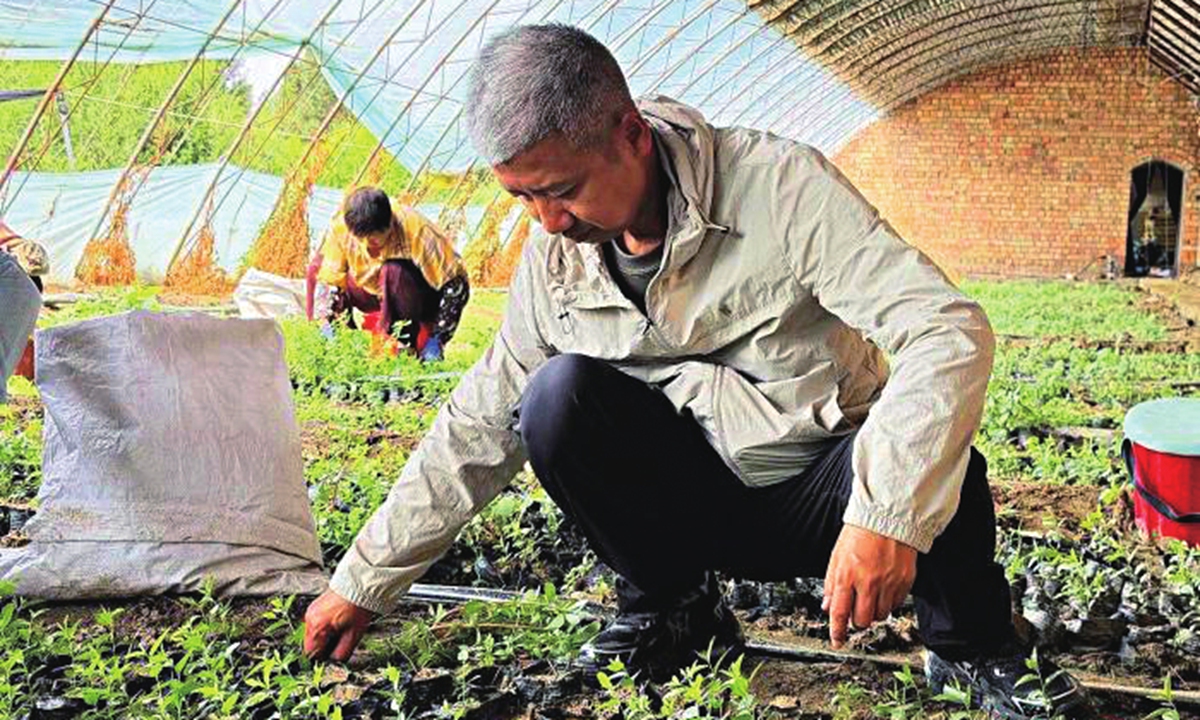
For over 30 years, Wensuyalatu, a member of the leadership group of the Urad Rear Banner forestry and grassland bureau, has made the Gobi Desert his workplace, dedicating his life to combating desertification, advancing ecological restoration through technological innovation, and helping local herders increase their incomes, according to the local bureau's official WeChat account.
Located on the edge of the desert in Bayannur's Urad Rear Banner, it is a key area in China's Three-North Shelterbelt Forest Program, a major ecological project aimed at strengthening the country's northern ecological security barrier.
However, early afforestation efforts in the desert were far from easy at the start.
The project covers 103,800 mu (about 6,920 hectares), including comprehensive treatment of 24,500 mu of desertified land, ecological restoration of 4,100 mu of non-desertified land, and 75,200 mu of enclosed grassland restoration. The project also includes the construction of 11 small-scale water conservation facilities, all of which required strict standards and extensive coordination.
The project also includes the construction of 11 small-scale water conservation facilities, all of which required strict standards and extensive coordination.
In 1991, Wensuyalatu, then in his early 20s, chose to devote himself to forestry and grassland conservation in the Urad Rear Banner. Since then, he has remained on the front lines of desertification control, witnessing the region's harshest environmental challenges and working to find solutions adapted to the fragile desert ecosystem.
In the early years, afforestation in the Gobi Desert was an extremely difficult task. The most critical planting season in spring often coincided with the strongest sandstorms of the year. Every year during the key afforestation period, Wensuyalatu would stay deep in the desert, guiding workers on planting techniques and management practices, while carefully overseeing every detail of the ecological restoration projects.
"Every spring, the wind and blown sand were so strong that it was hard to keep your eyes open. The sand hit your face like needles. During the day, we followed workers to dig holes and plant trees, and at night we stayed in temporary shelters to organize data and review the day's work. That was the normal routine for desertification fighters," Wensuyalatu recalled.
The road to restoring the desert was far from easy. Years of drought, low survival rates of seedlings, and skepticism from some local residents created major obstacles.
"At the beginning, it was really difficult. The climate was extremely dry, and many seedlings died after being planted. Some herders did not understand or support the work. They believed deserts were naturally barren and that no amount of effort could make trees grow there," Wensuyalatu said.
To change these perceptions, Wensuyalatu brought local residents to see firsthand the damage caused by desert expansion. Through visible results and long-term communication, he gradually won the understanding and support of the community.
Facing the ecological challenges of the Urad Rear Banner, Wensuyalatu began exploring new approaches beyond traditional restoration methods.
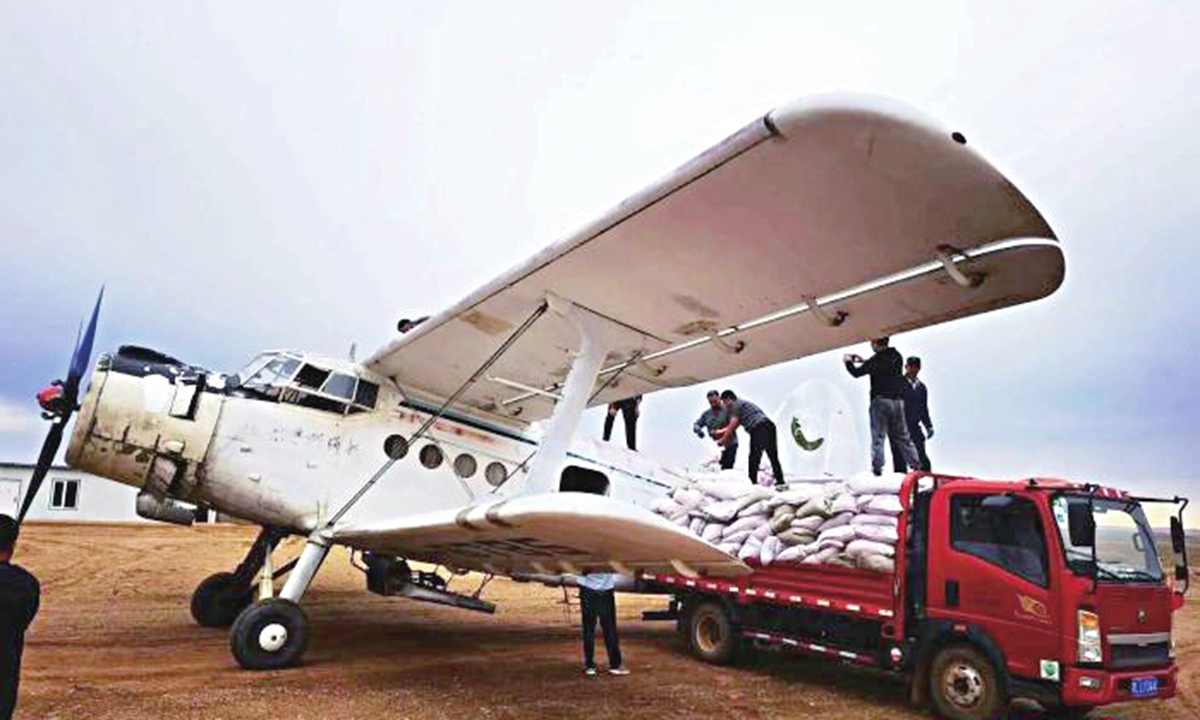
Since 2004, he has led efforts to tackle desert restoration challenges by introducing large-scale aerial seeding projects, creating a breakthrough approach for restoring degraded desert ecosystems in the region.
"Compared with traditional methods, aerial seeding is more efficient and can cover wider areas. Based on local climate and soil conditions, we select suitable desert plant seeds and precisely control the seeding height, density and timing to improve survival rates as much as possible and accelerate desert recovery," Wensuyalatu explained.
After years of effort, the aerial seeding projects under Wensuyalatu's leadership have restored more than 800,000 mu of desert land, with an effective restoration rate of 62.2 percent.
He also developed an integrated management approach combining "protection, management, retreat, restoration and publicity," establishing a mixed vegetation system of trees, shrubs and grass to curb desert expansion and reduce sandstorms at their source.
Beyond restoring greenery, Wensuyalatu has also focused on strengthening scientific research and protecting native desert species.
Starting in 2010, he devoted himself to the artificial cultivation of endangered native desert plants. After more than a decade of repeated experiments, he successfully developed cultivation techniques for rare species such as the endangered evergreen broadleaf shrub Ammopiptanthus mongolicus, Mongolian almond and drought-resistant elm.
Under his leadership, his team cultivated 6.5 million seedlings and completed more than 4,000 mu of high-quality afforestation projects, with seedling survival rates consistently exceeding 80 percent.
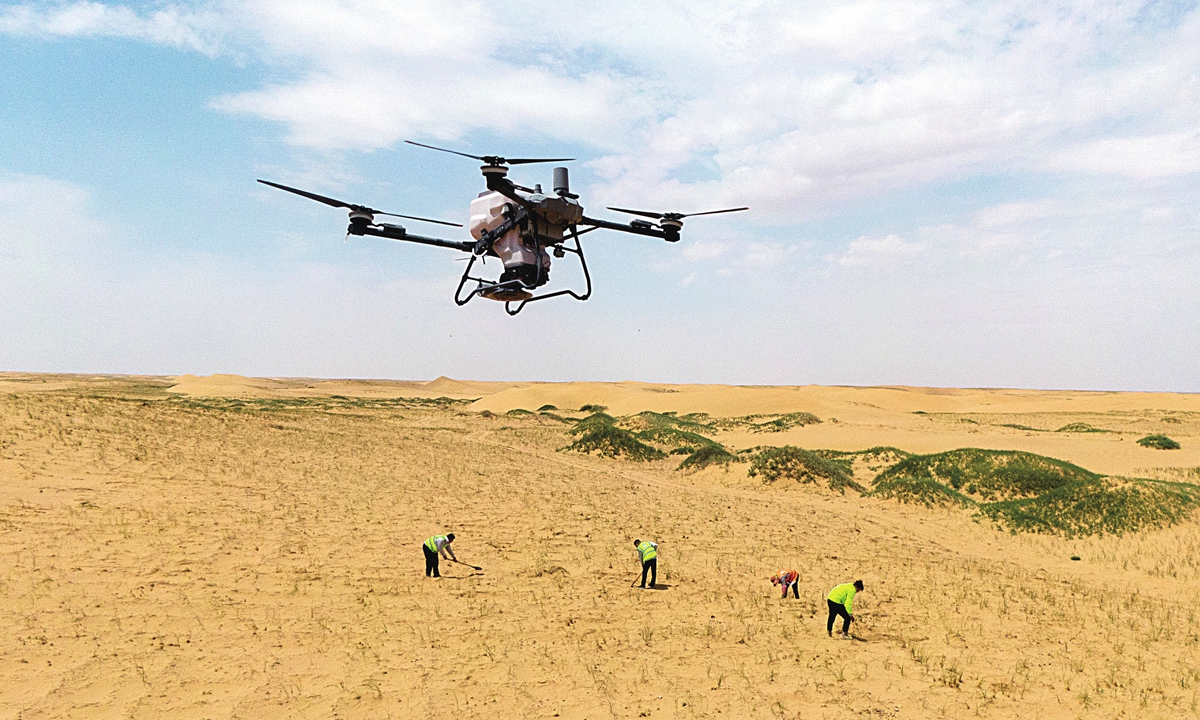
For Wensuyalatu, desert restoration is not only about creating ecological benefits, but also about improving people's livelihoods.
He has long promoted the idea that "trees should bring both ecological value and economic value." By leveraging local desert resources, he helped establish a 10,000-mu industrial base for desert plants and cistanche - a medicinal plant often grown in desert environments - across four key local villages, integrating ecological restoration with specialty desert industries.
"In the past, people thought desertification control was simply about planting trees - it took a lot of efforts but brought little income. Now things are different. By planting trees and developing industries such as cistanche cultivation, desert land can generate real wealth," a local herder said.
To ensure that local communities benefit from ecological development, Wensuyalatu introduced enterprises, supported family forest farms and professional cooperatives, and promoted large-scale, market-oriented operations.
The once barren desert has gradually become a "green treasure chest" for local herders, achieving a win-win outcome: greener landscapes, improved ecosystems, stronger businesses and higher incomes.
"Desertification control is not just an ecological project, but also a project that benefits people," Wensuyalatu said.
"Only when communities gain real benefits from protecting nature will they actively participate in ecological conservation. That is the key to making restoration efforts sustainable and achieving the vision that lucid waters and lush mountains are invaluable assets," Wensuyalatu said.
Global Times
。
Current article:http://www.feizengbubaipeirangnalouchuo.sbs/y2zg13w/04yr3.xlsx
Published on:12:32:21
相关新闻
- “金九银十”重大项目施工忙 央企订单旺_建设_基建
- “趁男友不在跟暧昧者要巧克力”,德芙客服就争议文案致歉:视频内容为个人创作,不代表品牌立场,已经处理
- 阿莫林执教曼联以来联赛场均拿到1.05分,英超倒数第五
- 黄仁勋再次演唱123:摩尔定律不复存在
- 手感不佳!生死战廖三宁3投0中得到4分1篮板6助攻
- 朝媒谴责高市早苗8月15日遥拜靖国神社并供奉祭祀费:军国主义野心膨胀到极点,日本刻意回避侵略历史、拒绝吸取教训,势必将重蹈历史覆辙
- Kiara Advani Celebrates Her First Christmas After Embracing Motherhood
- G1火箭85-95不敌勇士 球员评价:申京满分,5人及格,2人崩盘
- 8个月身体年轻近15岁,多项指标变好!45岁教授拿自己做实验,这4点可以直接“抄作业”
- 节后行情怎么走,机构这样说。全球流动性收紧预期升温,LPR仍有调降可能。四季度稳增长板块或有机会_政策性金融_经济
最后更新
- 最高人民检察院依法对王滨决定逮捕_存款_人寿保险
- 嘉义中秋烤肉惊现“烤全鳄”_鳄鱼_台湾
- 打了80场!吉莱斯皮谈全明星后投篮下滑:出场时间太多是原因之一
- No report of Chinese nationals injured or killed in Colombia earthquake: FM
- 全球首批“杭州产”抗癌新药获批上市
- 闭路电视解读5G网络4K视频:更快、清晰
- 【现货】8月26日全国菜粕现货价格汇总
- 腾讯国王荣光新英雄嫦娥免费发送活动正式开幕:仙女出世
- Poll shows US youth favor China engagement, reject restrictive policies; Washington’s China containment narratives lose traction: expert
- 东风日产向车主致歉:因服务器机房电力故障,导致车主APP登录、远程控制等线上功能出现无法使用的情况,目前正在全力抢修
热门新闻
- Chinese teenagers flock to tech frontline to touch the future amid AI study-tour boom
- 亚当斯:我打球不是为了钱 续约后雇了位懂行的人帮我打理钱财
- “侨聚之江 侨创未来”项目资本对接会(AI专场)举办
- ATP最新排名:兹维列夫重回世界第二、鲁内重返前十
- 马扎:和梅西交手是荣幸,对阿尔及利亚他应染红?他当时比较幸运
- Global Robot Application Exploration Program launched at 2026 World Robot Conference
- 祝乌日古木拉生日快乐!火力全开,持续在赛场上攻城拔寨
- 美以伊最新局势:美军称对伊海上封锁以来已拦截75艘商船;伊朗总统:国家应摆脱非战非和状态;最高领袖穆杰塔巴制定国家政策
- 上海一纹眉店用护手霜代替麻药制造剧痛,逼迫顾客加钱升级套餐,52人遭“疼痛”逼单,主犯被判1年7个月
- 短时暴雨和7~9级雷雨大风!杭州发布橙色预警!雨水这天开始减弱