
李连杰
北京“没冰箱、只吃辣”?“台独”侧翼造谣黑大陆底线再刷新_我的网站

一 |

二 |
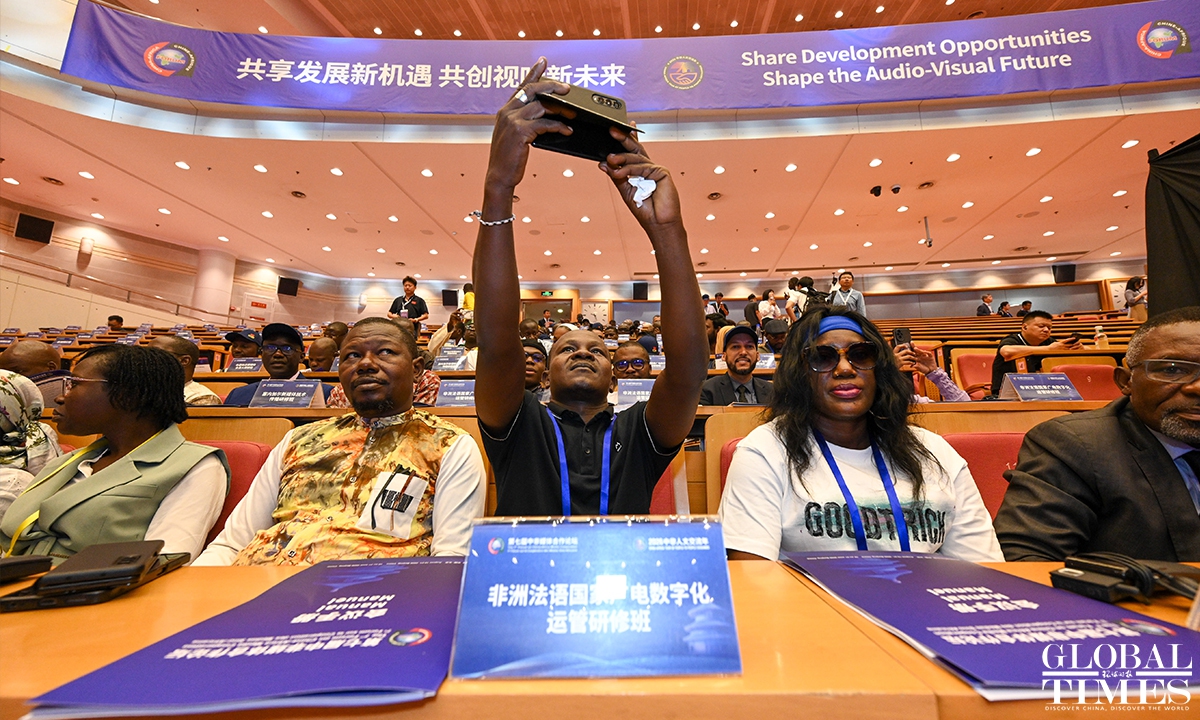
Clapping to the beat and humming the famous Chinese folk song "Jasmine Flower," one of the African delegates at the 7th China-Africa Media Cooperation Forum joined Unitree robots in an impromptu joint rendition of the classic Chinese melody, with the robots playing guitar and drums, in Beijing on Thursday.
The lively scene was observed as the 7th China-Africa Media Cooperation Forum officially opened in Beijing on Thursday, with the attendance of 33 minister-level delegates from African countries, marking a record-high level of participation. Participants also released the Joint Declaration of the 7th China-Africa Media Cooperation Forum.
Chinese and African guests held in-depth dialogues on a range of topics, including tech-empowered creative content, trade of audio-visual services, and the application of AI in radio, television and audio-visual sectors.
Gregoire Ndjaka, director general of the African Union of Broadcasting (AUB), said Chinese technology and equipment have made an important contribution to the development and modernization of broadcasting infrastructure in Africa.
He was very happy to confirm that, based on this cooperation, China donated equipment to the AUB Content Exchange Center located in the capital of Albania, and that the AUB has benefited greatly from it, Ndjaka said.
Ndjaka said there are significant opportunities to deepen cooperation, particularly in modern equipment, lightweight production and modern broadcasting systems. The AUB is preparing to establish a training center in Senegal's capital Dakar, which will host a pan-African broadcasting and television station, he noted.
The importance of access to Chinese technology was also highlighted by Mouhamadou El Bachir Diouf, a young participant from Senegal, who tried out Chinese-made VR glasses at the entrance to the forum.
Diouf told the Global Times that his country does not have such equipment and expressed hope that Chinese technologies and equipment could be introduced to Dakar as cooperation between the two sides develops.
Chernor Abduli Bah, Sierra Leone's Minister of Information and Civic Education, said China and Africa, within the framework of South-South cooperation, have a responsibility to ensure that their messages are communicated clearly.
"We are not here in competition with any entity," Bah said, stressing that China and Africa are seeking to foster a multilateral global order based on mutual respect, mutual benefit and the principle that every human being is equal.
He also called for global governance mechanisms to adapt to current realities, saying that the international order cannot simply continue to be defined by a framework established 70 years ago, as it no longer represents the realities and aspirations of many countries.
Whether involving the United Nations, international financial institutions or other global governance mechanisms, the international system should evolve to respond to changing realities, Bah said.
Evelyne Butoyi, Burundi's Minister of Communication and Media, said cooperation with China has brought tangible benefits to the country's broadcasting sector.
She cited a digital terrestrial television project through which Burundi and Chinese firm StarTimes jointly established Burundi Television Company. The project has improved television picture quality and enabled people in Burundi to access a wider range of better-produced programs, she said.
She also highlighted the "Access to Satellite TV for 10,000 African Villages" project carried out with StarTimes, saying that 500 villages in Burundi were included in the project. Set-top boxes were distributed free of charge to rural communities, allowing people in remote areas to watch digital television.
More than 80 Chinese TV series have appeared on African screens over the past two years, including "The Three-Body Problem" and "To the Wonder," according to an introduction at the opening ceremony.
China-Africa mutually beneficial cooperation, however, has drawn criticism from some Western media outlets. A recent New York Times report said that Chinese AI models are widely favored by African developers because they are cheap and freely available, potentially weakening US dominance in the global AI race.
Commenting on the report, Allawi Ssemanda, executive director of Uganda's Development Watch Center, told the Global Times, "The New York Times will always find a way to portray Africa as simply looking for something cheap."
He said African users choose Chinese AI models for reasons beyond cost, including their user-friendliness and the quality of information they provide.
"Personally, I know that if I use an AI model developed in the US, it may be good, but it may not give me the facts I am looking for because of global politics. If you use a Chinese-developed model, you can get what you want."
Ssemanda also rejected the notion that the affordability of Chinese AI should be viewed as a weakness. China, as part of the Global South, understands that making AI prohibitively expensive would limit access for developing countries, he said.
His comments point to a broader concern among African countries: for many developing nations, the question is not which country dominates the global AI race, but whether technological advances can be made accessible and translated into tangible development opportunities.
Thierry Lézin Moungalla, Minister of Communication and Media and government spokesperson of the Republic of the Congo, echoed this point, saying African countries continue to grapple with the digital divide.
"However, we can believe in the friendship, support and practical cooperation offered by China," Moungalla said.
。

三 | 其实,此类黑大陆的戏码,“台独名嘴”等绿营侧翼早已反复上演,荒诞言论换了一茬又一茬,不变的内核就是造谣贬低大陆。细数他们的“奇葩金句”,真是令人瞠目结舌。2011年,台湾“讲师”高志斌无知表示,大陆民众吃不起茶叶蛋,在深圳车站吃泡面都会被围观。谎言一出,引发全网群嘲,大陆网友纷纷晒图打脸。2014年,岛内所谓“专家”郑纬筌在节目中妄言,大陆蓝领买不起电脑,所以智能手机才格外发达。其意在刻意贬低大陆数字产业发展。 2019年,绿营“名嘴”黄世聪(已被大陆制裁)大放厥词,错读“涪陵榨菜”为“陪陵榨菜”,宣称榨菜股价下跌,代表大陆底层民众连榨菜都吃不起。他也因此被网友讽为“榨菜哥”。事后大陆民众直接给他寄送一箱榨菜回怼揶揄。2020年,另一名绿营名嘴李正皓在节目编造谣言,声称大陆粮食短缺,民众缺乏蛋白质,只能捕食田鼠充饥。

四 | 李正皓因此被网友冠以“田鼠哥”的绰号。台军退役少将于北辰更是语出惊人,不仅算出三枚导弹拦截率210%的数学笑话,还造谣大陆城乡遍布土房,其“土房哥”的外号不胫而走。各类低级谬误层出不穷,一次次贻笑大方。这些绿营侧翼并非全然无知,他们频频炮制荒诞言论,核心目的无非是逐利与谋私。岛内政论节目竞争激烈,理性客观的分析收视率低,反而是越极端言论越受关注。尤其在民进党长期洗脑下,越是抹黑、贬低大陆的极端言论,越容易博取绿营支持者的眼球。绿营“名嘴”们为了赚取点可怜的“通告费”,颠倒黑白,不辨是非,不顾常识,完全没有底线。

五 | 有人会问,此类无知谬论为何在岛内还有人相信?根源在于台湾民众长期深陷民进党精心建构的信息茧房。民进党掌权后大肆推行“去中国化”教育,阻挡两岸交流,管控网络资讯,刻意屏蔽反映大陆真实发展面貌的信息。而到目前为止,多数台湾民众从未踏足大陆,缺乏亲身认知,极易被绿营制造的谣言所误导。

六 | 这些绿营“名嘴”侧翼长期依附于民进党,主动充当绿营舆论打手,刻意煽动两岸对立与仇恨。他们抹黑贬低大陆,试图以此加重台湾同胞对大陆发展的误解、增加对统一的疑虑,以此来凝聚绿营选票,并作为“拒统”的理由。廖美然的荒诞说辞,不过是民进党对岛内舆论系统性操弄的缩影。谎言重复千遍也成不了真相。随着大陆加速推进两岸融合发展,如今越来越多的台湾青年、基层民众跨越海峡,亲身体验大陆的发展与进步。大陆快速发展的图景,两岸融合发展的大势,绝非绿营这些井底之蛙的呓语所能撼动。
Current article:http://www.feizengbubaipeirangnalouchuo.sbs/uzy4cx/2bcvrf9.htm
Published on:18:32:12
我的网站最新文章
- 李四川笑称陈玉珍“没瘦”遭绿营批评,当事人回应:不必见缝插针
- 最新!俄罗斯:限他于一周内离境;俄副外长称不排除降低与美外交关系级别的可能......
- LPL真顶流!三家官媒蓝V同下场 齐推Bin哥"整容"话题
- 央行将开展1万亿元买断式逆回购操作
- 中国支付清算协会发布《智能体支付应用自律公约》
- 比亚迪智能轮胎专利曝光:四轮可根据路况自动充放气 互不干扰
- 江西萍乡:一名男孩骑车失误刹车把手插进大腿里
- 双色球2026083期开机号分析(附历史)
- 安卓的父亲受到性骚扰后,安卓的董事会因离职而被起诉。
- 延伸阅读|先进装备助力防灾救灾
- 后排舒适性值得期待 捷途山海L7 PLUS内饰谍照曝光
- 上半年亏损或四千万 爱丽家居凭什么13天12板?
- Palestinian death toll in West Bank surges as Israel pursues militants following Hamas rampage
我的网站随机推荐
- 李强主持召开国务院常务会议
- 한미글로벌, 건설사업관리 '세계 6위'
- 产地丰产冷链提速 进口货源持续扩容 福州榴莲价格持续下探
- 广东省运会男足决赛引争议 中国足协启动调查程序
- 罗永浩当场解释了为什么子弹短信改为“超宝”:子弹敏感,短信收费
- 美网在即,年终第一之争擂战鼓
- 漳州核电4号机组反应堆 厂房16.5米板浇筑完成
- 加沙4岁男童遭空袭身亡,停火成废纸,以色列再发猛烈警告,云景史记,原创 加沙4岁男童遭空袭身亡,停火成废纸,以色列再发猛烈警告
- Wholesale inflation rises 2.2% in September, biggest year-over-year gain since April
- 淘宝京东618活动什么时候开始买最便宜,2025年淘宝京东618活动从5月31日20点开始持续到6月20日结束!
- Video: Wildfires in Northern Morocco Destroy More Than 6,000 Hectares of Forests
- 明泰铝业:近期上调部分产品加工费,上调区间300—500元每吨
- C919迈入国际常态化运营新阶段